
The Platform

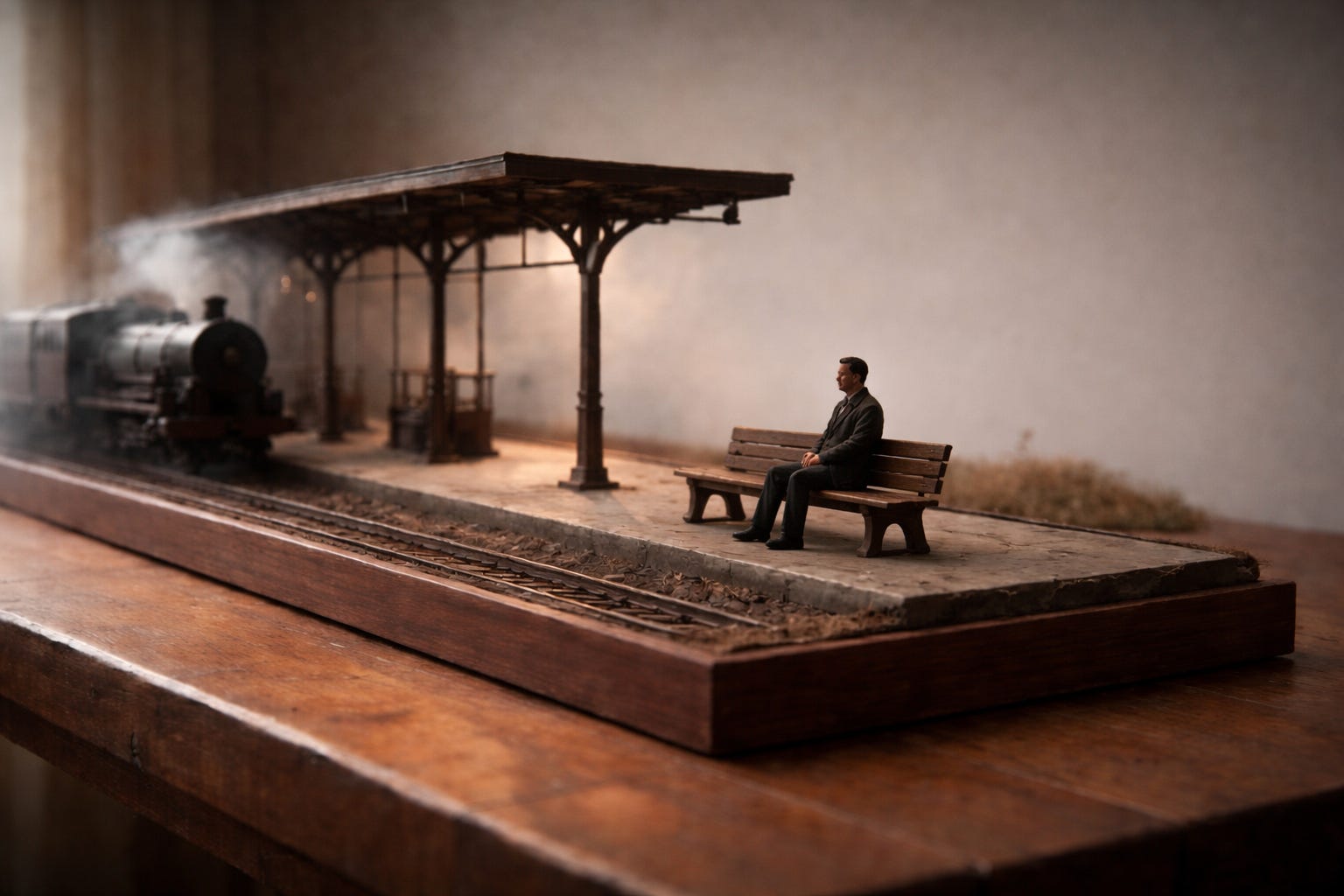
The trains always left in the morning.
Before the sun had decided what kind of day it intended to be, the platform would already be filling with the quiet movements of departure. Boots against concrete. The slow scrape of trunks dragged across the ground. Mothers speaking too carefully to their sons, as though the right tone might hold something in place.
Steam gathered above the engines and drifted through the iron ribs of the station roof.
From the ticket window she watched them arrive.
Some came laughing too loudly, the sound brittle around the edges. Others moved with the stiff politeness of men pretending they were only traveling for work. A few stood very still beside the doors of the train, studying the metal as though memorizing its shape might make the journey easier.
She stamped tickets. She counted change. She slid small rectangles of paper beneath the brass rail one after another while the line slowly shortened.
It had been like that for three years.
War had its own rhythm. The station kept time with it.
He appeared sometime in the second winter.
She noticed him first because he never stood in line.
While the others crowded the window with letters folded in their pockets or orders tucked carefully inside coat sleeves, he remained on a bench near the end of the platform where the shadow of the roof touched the open air.
He arrived early. Earlier than most of the soldiers. Earlier even than the vendors who set up their coffee carts beside the tracks.
Then he sat.
He watched the departures without moving, his coat pulled close around him against the morning cold. Sometimes he stayed until the last train had gone and the station fell quiet again.
The first few weeks she assumed he was waiting for someone.
He never greeted anyone and no one greeted him.
Spring came and softened the air around the station. The mornings lost some of their bitterness. The trains still left filled with men who tried not to look back.
He continued to sit on the bench.
She found herself looking for him when she unlocked the ticket window.
The bench felt wrong when it was empty.
One morning he came closer.
He stood in the short line and waited his turn without speaking to anyone. When he reached the window he did not place any money on the counter.
For a moment he simply looked at her.
"I don't need a ticket," he said quietly.
She rested her hands on the wooden ledge of the window.
"Most people who stand in line here do."
"I thought I should see what it felt like."
The station bell rang somewhere down the platform.
A train released a long breath of steam behind him.
She studied his face, trying to decide whether the remark had been meant as humor.
It had not.
"Are you traveling today?" she asked.
He shook his head.
"No."
He stepped aside so the man behind him could reach the window.
The line moved again.
The train departed. The platform emptied. The station returned to its quieter afternoon rhythm, where the sound of pigeons under the roof could sometimes be heard between the distant shunting of freight cars.
He remained on the bench.
The next week he came again.
This time he did not stand in line. He waited until the rush of departures had thinned and then approached the window while she was counting the morning receipts.
"Why do you come here?" she asked before he could speak.
He seemed almost relieved that the question had finally been asked.
"My brother left from this platform," he said.
She waited.
"He never came back."
The wind shifted through the open end of the station and stirred the loose papers on her desk.
"I'm sorry," she said.
He nodded slightly as though the words had been expected and politely received.
"I thought I would leave too," he continued after a moment. "At the beginning."
"But you didn't."
"No."
Another train bell rang farther down the line, though the track it belonged to remained empty.
He glanced toward the sound.
"I keep coming here to see if courage might arrive one day," he said. "I thought perhaps it traveled by train."
"Has it?" she asked.
"Not yet."
The following weeks developed a quiet pattern neither of them acknowledged.
He would arrive before the soldiers. She would see him take his place on the bench while the morning fog still clung to the tracks.
Sometimes he watched the trains leave without speaking to her at all.
Other mornings he came to the window once the crowd had thinned and stood there while she sorted the day's tickets into neat stacks.
Their conversations wandered through small territories at first.
The stubbornness of pigeons. The way the station clock always ran a minute fast. The curious fact that soldiers tended to speak more softly the closer they stood to the train.
Gradually the pauses between their words grew less careful.
One gray morning she asked him how old his brother had been.
"Twenty-two."
"And you?"
"Twenty-four."
"You're older."
"Yes."
The answer seemed to trouble him.
"Does that matter?" she asked.
He watched a pair of soldiers embracing their mother near the luggage cart.
"He was always braver than I was," he said.
The train whistle cut through the station roof and scattered the pigeons.
When the train finally pulled away she saw him studying the empty track with an expression that looked less like regret than something he hadn't named yet, as though the world had asked something of him and he hadn't understood.
Summer arrived with long evenings that turned the metal rails gold.
The war did not end.
The trains continued their morning departures.
One evening she closed the ticket window early and stepped out onto the platform where he was sitting.
The station had fallen quiet. Only a single freight train rested on the far track, its cars humming faintly in the heat.
"You believe courage comes all at once," she said.
He looked up at her.
"Doesn't it?"
"I don't think so."
She sat beside him on the bench.
The rails stretched away into the dusk like lines drawn by someone who believed distance could solve most things.
"I think courage arrives slowly," she continued. "In pieces so small you don't notice them until they've already changed something."
He considered that.
"I come here every week," he said after a moment.
"Yes."
"I stand in line sometimes."
"Yes."
He looked down at his hands.
"That might be one."
She nodded.
The evening wind carried the faint smell of coal smoke from the freight engine.
"Maybe it is."
He sat beside her without speaking for a long time.
Somewhere in the station a clock ticked toward tomorrow morning, toward another train, toward another chance for someone to leave or remain exactly where they were.
Eventually he asked quietly, "If courage does arrive in pieces… how will I know when I have enough?"
She watched the rails disappear into the distance.
"You might not," she said.
"And then?"
"Then you choose something anyway."
The platform grew darker as the sun settled behind the hills.
When she finally stood to return to the ticket office he remained on the bench, though the way he watched the empty track had changed slightly.
Not like a man waiting for courage to arrive.
More like someone beginning to understand he might have been carrying small pieces of it all along.
This is a quiet, carefully paced story .. it has a beautifully described setting, yet speaks of more, the setting itself becomes a metaphor for what is, finally, said…