
The Quarantine Ship

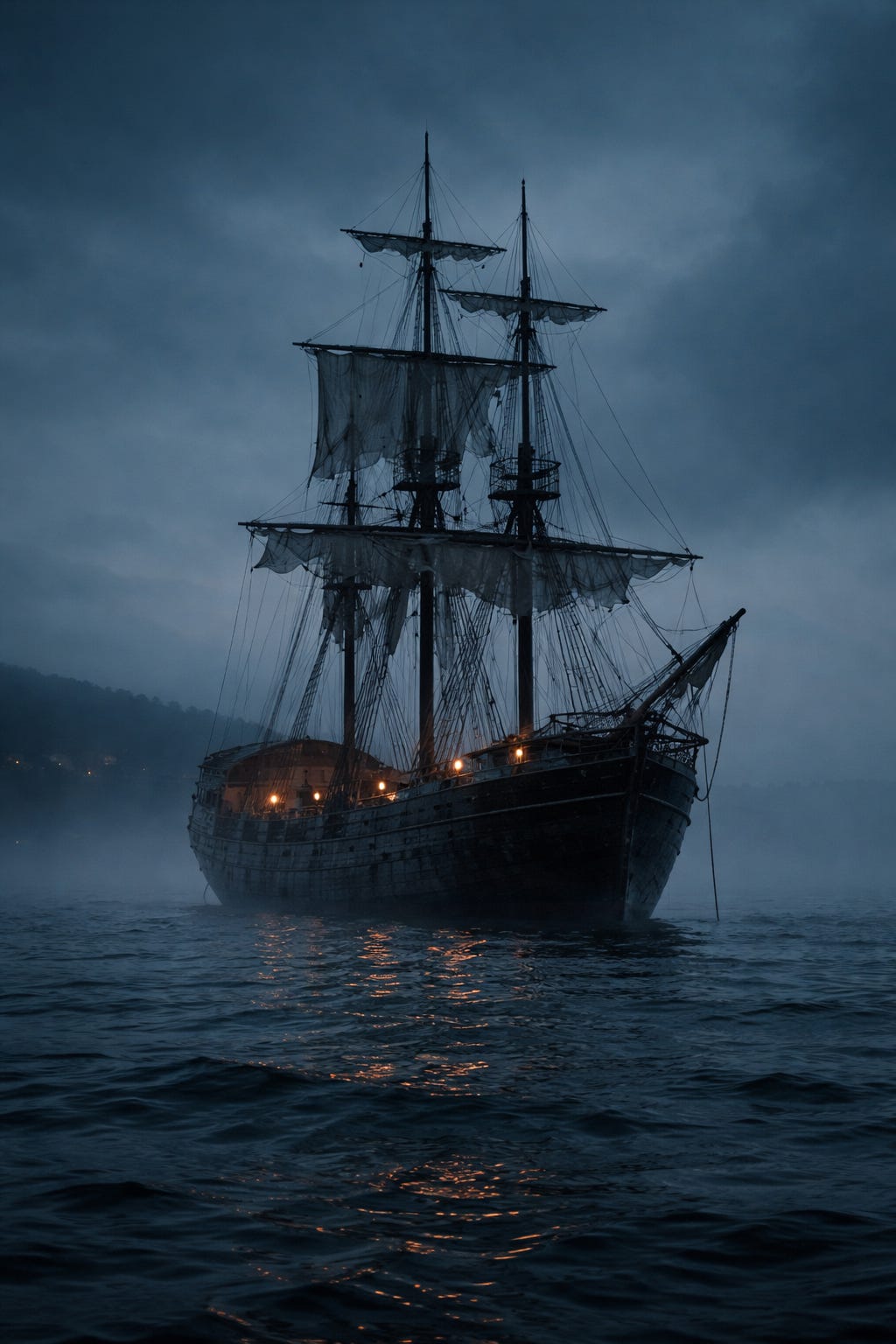
The ship never quite reaches shore.
It lingers beyond the harbor like a thought no one wishes to finish. Lanterns burn along the coast at night, a thin ribbon of safety denied to those aboard. No one is permitted to disembark. The fever must choose its course in isolation.
She counts days by the change in smell.
Salt first. Then sickness. Then something metallic that clings to the back of the throat. The decks are scrubbed constantly, though the wood remembers what it has absorbed.
At dusk, when the light thins and the horizon dissolves into a blurred seam between sky and water, she hears it for the first time.
A violin.
Not loud.
Not desperate.
Measured.
The melody drifts upward from below deck, threading itself through stairwells and narrow corridors. It does not belong to the sailors. It does not belong to the physicians who move briskly between hammocks with cloth pressed to their faces.
She asks one of the crew about it.
"There is no musician," he says, not unkindly. "You must be tired."
She has been tired for weeks.
Still, the sound returns the next evening, precise in its timing, beginning just as the sun sinks behind the Italian hills.
She follows it.
The lower deck is darker than it should be, lit only by oil lamps spaced too far apart. The shadows between them hold a thickness that feels almost structural. The ship creaks and sighs as if shifting in sleep.
The music continues, unbothered by her approach.
She passes hammocks where bodies lie too still. Names have been recorded already in the ledger. Some crossed out in ink, marked deceased. Some awaiting decision.
The melody turns inward, circling itself, as though inviting her deeper.
At the far end of the corridor, near the cargo hold where the worst of the sick were once confined, she sees him.
He sits on a crate, violin tucked beneath his chin. His coat is dark and worn at the cuffs. His hands move with quiet assurance. He looks up before she speaks, as if he has been expecting her.
"You are not meant to be here," he says gently.
She glances around.
"Nor are you."
His mouth curves faintly.
"That depends."
She steps closer, studying his face. It is pale but not waxen. The eyes hold clarity, not fever. She recognizes him then, not from memory, but from the ledger. His name had been read aloud two days ago, followed by a short prayer and the thud of a weighted sack dropped into water.
"They recorded you," she says.
"They record many things," he replies, bow moving steadily across the strings.
The sound of it seems to soften the wood around them. The air feels less thick near him.
"You are dead," she insists.
He tilts his head, considering the word as if it has several meanings.
"I am not a ghost."
The bow pauses for a breath.
"The sea is."
The statement unsettles her more than denial would have.
The ship lurches slightly, though the water outside appears calm.
She listens to the silence between notes.
"You were thrown overboard," she says quietly.
"Yes."
"And yet you sit here."
"Yes."
He resumes playing, the melody shifting into something slower, less contained.
"When the sacks sink," he continues, "they do not fall forever. There is a place where the sea keeps what it wants."
Her pulse quickens.
"You mean hell."
He shakes his head, almost amused.
"Hell requires judgment. The sea requires only weight."
She imagines bodies suspended in dark water, garments drifting like weeds. She imagines eyes open beneath the surface, watching the hull from below.
The music deepens.
The oil lamps flicker.
She feels something beneath her feet, a pressure against the planks, subtle but deliberate.
"You hear them," he says, not asking.
She does.
A faint rhythm under the melody, like fingers tapping from beneath.
"You survived," she says, though she is no longer certain to whom she speaks.
He lowers the violin slightly.
"Survival is a surface condition."
The ship tilts again, more noticeably now. The corridor seems to lengthen, stretching toward the bow.
"You should not be here," he repeats.
"I followed the sound."
He studies her.
"And what do you intend to do with it?"
The question hangs.
She does not know.
Above deck, a bell rings, signaling the hour. The light outside has faded entirely.
He lifts the violin once more.
"This ship is not drifting," he says softly. "It is being held."
The bow draws across the strings, and the melody shifts into something almost tender. It carries grief but not fear. It carries invitation.
"You think the plague is the danger," he continues. "It is only the excuse."
The tapping beneath the floorboards grows more insistent.
She takes a step back.
The wood yields slightly under her heel, as if softening.
"They want us," he says.
"Who?"
He smiles, though there is no cruelty in it.
"The ones recorded."
The ledger above deck lists names in neat columns. Dates. Causes. Disposals. She pictures the ink bleeding through the page, sinking into the wood of the table.
"You said you are not a ghost," she whispers.
"I am not."
"Then what are you?"
He resumes playing fully, and for a moment the question dissolves into sound.
When she looks again, the oil lamps burn lower, their flames elongated as if pulled downward.
The corridor narrows.
"You should return to your cabin," he says.
"Will you come with me?"
His gaze softens.
"I never left."
The ship creaks, a deep, resonant groan that feels less like strain and more like adjustment.
She turns and walks back toward the stairs, the melody following her, threading through the darkness.
Above deck, the sea is calm, almost glass.
The coast remains distant, lanterns flickering faintly against the hills.
She leans over the rail and looks down.
For a moment she sees only black water.
Then, just beneath the surface, shapes shift.
Not drifting.
Waiting.
Behind her, the violin continues, steady and patient, as if keeping time not for the living aboard the ship, but for the weight below that has already decided where this vessel will finally rest.
"There is no musician," he says, not unkindly. "You must be tired."♥️
This is awesome, love the ambiguity and pacing. I was imagining all sorts with each snippet. And the setting was perfect immersion. Thanks for sharing!